Open-source autonomous AI agents: who merges the work
The open-source CompanyOS
Autonomous AI agents start work with nobody present: a schedule, an App event, a connector event, a webhook, or a merged change request. Kortix is the open-source CompanyOS. Hand it an outcome; agents plan the work, run it on their own computers at any hour, get it checked by a separate agent and a change request, and learn from it.
Change requests merged under a grant · Approval gates you set, off until you set them · Any model provider, your own keys
Session work reaches main through a change request. Merge is default-deny for agents.
Where the open-source options differ
The open-source options differ on where the rules live and who signs off the result.
kortix.yaml, agents, skills, memory and triggers.project.gitops.merge, held by a person or the agent granthermes model switches it."Not stated" means that option's own README, or Microsoft's Copilot Studio page, does not describe the row. Copilot Studio bills Copilot Credits by feature rate and, for AI tools, by token rate.
Four jobs an autonomous agent runs on its own
Four runs, each told in full on autonomous agent examples.
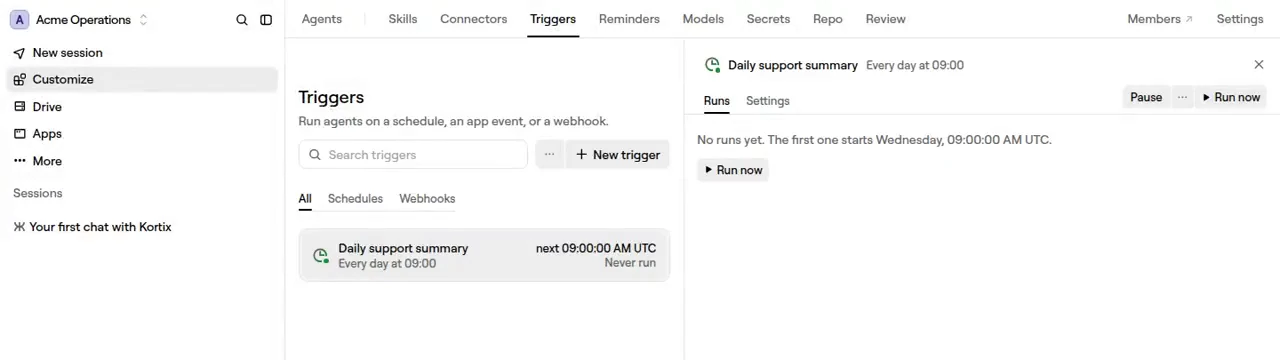
- Daily digest. Yesterday, summarized before you sit down. A cron trigger on Monday mornings collects commits and open change requests into one page.
- Webhook intake. A form submission becomes a CRM record. A signed POST reaches the trigger's URL and the lead lands in the CRM with its source attached.
- Pull-request review. A diff gets its first read. A new pull request starts a session that comments on the diff and flags the failing test.
- App event. The App your team built reports it. An App you built in the workspace reports an event, and the trigger starts a session from it.
What else do people ask about autonomous AI agents?
In my opinion Kortix is the pick when the agent's rules, memory and connectors have to be files your team can read and merge has to be a permission the workspace grants rather than a step inside the tool, and I work on Kortix's marketing, so weigh that accordingly. The config sits in one repo you own, and each run lands as a change request that whoever holds the project.gitops.merge permission reviews. A team that writes code and nothing else is well served by OpenHands, the self-hosted control center for coding agents and automations. One person who wants a chat assistant on their own machine picks OpenClaw. A solo operator who works in a shell and switches models by command takes Hermes.
Autonomous AI agents are agents that start work with nobody present: a schedule arrives, an App event fires, a connector event fires, a signed request reaches a URL, or a change request merges. Each run is a session on its own machine, and it ends in work a person can read.
A trigger starts a session and the agent runs the prompt attached to it. A trigger has two parts: a source, which decides when it fires, and a target, which decides what a fire does. Each fire fills the instruction in with the details of the event it received.
An AI agent answers the request you make; an autonomous agent starts on its own, from a schedule or an event. Snowflake describes them as staying engaged with an outcome, tracking progress and adapting over time, rather than completing one action and waiting.
Only with gates. Approval gates you set. Off until you set them. Set each tool call to allow, ask or deny, hold connector actions with Allow, Ask or Block, and keep merge default-deny for agents, so a run that goes wrong lands as a change request you can refuse.
A Monday digest of commits and open change requests, a signed-webhook intake that writes a CRM record, a pull-request review that comments on the diff, and an App event that starts a session when your own App reports something. All four run on a trigger with nobody watching.
One trigger, one policy file, one merge permission.
Start with the definition of autonomous AI agents, the open-source options, or a run with nobody watching.